

Sarvam has released Sarvam Prism, a System One decision model built on Sarvam 105B.
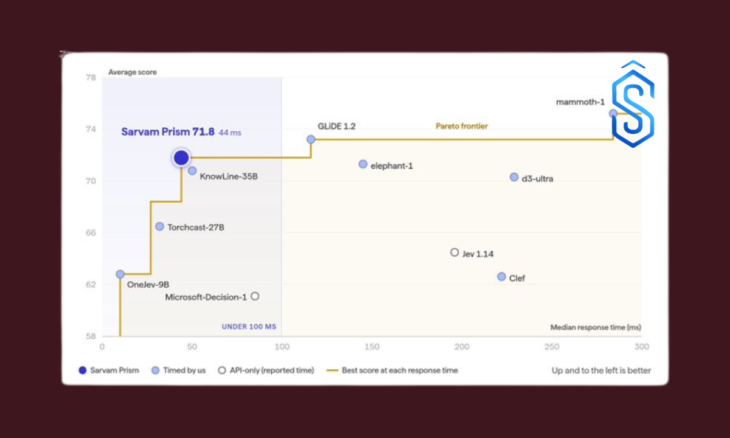
The company says Sarvam Prism establishes a new point on the Pareto frontier of accuracy and speed among the 25 decision models it tested, with an average score of 71.8 while responding in 44 milliseconds on an NVIDIA B200 GPU.
Sarvam Prism is designed for enterprise decision-making workflows, where a large part of the work involves a sequence of fast and intuitive decisions.
The model is intended to provide calibrated outputs that enterprises can use when automating workflows and making decisions based on confidence thresholds.
Sarvam Prism Targets Accuracy and Speed
Sarvam Prism was tested against 24 other decision models across three indices.
Sarvam said the models were evaluated on the same benchmarks, with response times measured on the same B200 hardware using the bundled inference code wherever the models could be run.
The Sarvam Prism model recorded an average score of 71.8 across the three indices, with a median response time of 44 milliseconds per request.
The company said this makes Sarvam Prism the highest-scoring model among the 25 models tested that responds in under 100 milliseconds.
Several models recorded higher overall scores, but Sarvam said they took between two and six times as long to respond.
The models tested included mammoth-1, GLiDE 1.2, elephant-1, StartLux-27B, KnowLine-35B, d3-ultra, KnowLine-26B, AutoTrust-JEV-27B, OneJev-27B, H2O-Lightning-31B, Perplexity Decider v1.2, d3, Torchcast-27B, StartLux-9B, VisionJEV, Jev 1.14, Amos 1 large, StartLux-4B, KnowLine-4B, OneJev-9B, Clef, Microsoft-Decision-1, Perplexity Decider Flash and Clef-Flash.
Among the tested models, mammoth-1 recorded the highest average score at 75.2, followed by GLiDE 1.2 at 73.2. Sarvam Prism recorded 71.8, followed by elephant-1 at 71.3.
Sarvam Prism’s 44-millisecond response time was among the fastest in the comparison while maintaining an average score above 71.
Sarvam Prism Benchmark Scores
Sarvam Prism recorded a score of 67.0 on the Jev Decision Index, 65.9 on the Artificial Analysis recreation and 82.5 on the Indian-language benchmark.
Its overall average score was 71.8.
For comparison, Perplexity Decider v1.2 recorded 67.7 on the Jev Decision Index, 61.2 on Artificial Analysis and 75.0 on Indian languages, resulting in an average score of 68.0.
Jev 1.14 recorded 60.7, 61.9 and 70.8 respectively, resulting in an average of 64.5.
Clef recorded 61.7, 54.8 and 71.2, with an average score of 62.6.
Microsoft-Decision-1 recorded 57.8, 55.6 and 70.0, resulting in an average of 61.1.
The company said Sarvam Prism performs particularly strongly on the hard questions in its recreation of the Artificial Analysis Decision Index. These questions include an “I don’t know” option and reward a model for avoiding guesses through calibrated decisions.
Sarvam also said Prism performs on par with or better than the best models tested on Indian languages.
Sarvam Prism Focuses on Calibrated Confidence
A key feature of Sarvam Prism is calibrated confidence. Sarvam said an enterprise automating a decision needs to trust the model’s confidence in its output.
The company explained that an automated decision can be acted upon only when the model’s confidence crosses a specific threshold. This is considered safe only when the confidence output is calibrated, meaning the model’s actual error rate should be lower than its expected error rate.
Sarvam evaluated Prism’s calibration using public benchmarks from the Jev Decision Index and an internal Indian-language benchmark.
At 90% confidence or higher, Sarvam Prism predicted an error rate of 3.3% for English answers and recorded an actual error rate of 2.2%.
For Indian languages, Sarvam Prism predicted an error rate of 5.4% and recorded an actual error rate of 4.4%.
Sarvam said Sarvam Prism made fewer errors than its confidence scores predicted across every confidence threshold tested, ranging from 50% to 95%, in both English and Indian languages.
For English answers at 90% confidence or higher, Clef predicted 2.8% errors and recorded 2.3%. Perplexity Decider predicted 1.4% and recorded 2.0%, while Microsoft-Decision-1 predicted 1.7% and recorded 3.1%. Jev 1.14 predicted 1.3% and recorded 3.5%.
In Indian languages, Clef predicted 3.9% errors and recorded 15.3%. Perplexity Decider predicted 3.0% and recorded 8.1%. Microsoft-Decision-1 predicted 3.0% and recorded 10.1%, while Jev 1.14 predicted 3.4% and recorded 16.1%.
The English evaluation covered 37 public benchmarks and 226,088 questions. The Indian-language evaluation used the same benchmarks in 10 Indian languages and Hinglish, covering 20,108 questions.
Sarvam Prism Gives Consistent Answers Across Option Orders
Sarvam also tested whether changing the order of options could affect the answer generated by Sarvam Prism.
The company evaluated Prism across 2,000 questions. The questions were run four times with shuffled options and four times without shuffling.
Sarvam said Prism’s answers remained the same across every shuffle when the options were first placed into a fixed order before scoring.
With the options in their original order, Prism’s answer changed in 4.0% of the 2,000 questions when the options were shuffled. After Prism introduced the fixed-order step, the answer changed in 0 of the 2,000 questions.
Sarvam Prism recorded 0.0% changes when options were shuffled after the fixed-order process and 0.0% when the same request was resent four times.
Clef recorded 0.1% changes when options were shuffled and 0.0% when the request was resent.
Microsoft-Decision-1 recorded 4.8% changes in both tests.
Jev 1.14 recorded 12.3% changes when options were shuffled and 5.6% when the same request was resent.
Sarvam said Perplexity Decider, GLiDE 1.2 and mammoth-1 produced the same answer to the same request but changed 9% to 10% of answers when options were shuffled.
According to the company, Sarvam Prism, when reading options in the order they are sent, gives the same answer to the same request and changes 4.0% of answers when options are shuffled.
Prism addresses this by putting options into one fixed order before scoring them, regardless of the order in which they arrive, while returning each probability under the original option name. Sarvam said this resulted in no changes across the 2,000 questions.
Sarvam Prism Tested on Enterprise Use Cases
Sarvam said it has tested Sarvam Prism on several real-world use cases, including speech-to-speech harness, trace evaluations, prompt injection guardrails, intent routing for customer support, model routing and document intelligence.
The company said it is sharing early benchmarks and will release more over time.
Sarvam Prism for Agent Trace Evaluations
Sarvam has also evaluated Prism for agent trace evaluations, where agent work needs to be checked for whether a task succeeded and whether a particular run requires human review.
The company used three sets of recorded runs for the evaluation.
AgentRewardBench contains web-agent runs on AssistantBench, VisualWebArena, WebArena and WorkArena, with labels provided by experts.
τ-bench contains customer-service conversations labelled according to whether the task was completed.
Who&When and TRAIL contain failed runs labelled with the step and agent responsible.
Five models were scored on the same 700 runs, covering 1,770 questions.
Sarvam said each answer was checked against a known correct label rather than another AI model’s judgement.
For determining whether a task succeeded or required human review, labels came from human experts who reviewed each web-agent run in AgentRewardBench or from the environment’s automatic check of the final result in τ-bench.
For identifying which agent caused a failure, human annotators marked the responsible agent in the Who&When and TRAIL datasets.
Sarvam Prism recorded an overall accuracy of 78.5% across all questions in the agent-run evaluation.
The model recorded 75.0% accuracy in determining whether a task succeeded, 86.4% in identifying whether a run required human review and 69.6% in identifying which agent caused a failure.
Clef recorded 71.6%, 80.4% and 60.9% respectively, with an overall score of 76.4%.
Jev 1.14 recorded 71.8%, 81.9% and 65.2%, also resulting in an overall score of 76.4%.
Microsoft-Decision-1 recorded 71.3%, 83.4% and 45.7%, with an overall score of 75.7%.
Claude Haiku 5.5 recorded 66.0%, 77.9% and 37.0%, with an overall score of 70.7%.
Sarvam said Prism scores a full agent run in about half a second on a single GPU. It reads the trace once and scores all five questions together.
The company said Claude Haiku 5.5, called through its API, takes a median 2.5 seconds per run and costs $0.64 per 1,000 runs.
Sarvam said this makes Sarvam Prism a faster and cheaper alternative for this use case.
Prism can also handle up to 131,072 tokens per question, allowing long traces to be evaluated in one pass rather than being split into chunks.
Sarvam Prism for Agent Security Guardrails
Sarvam also tested Sarvam Prism for agent security guardrails using an internal cybersecurity benchmark.
The benchmark contains 5,517 questions across nine tasks and was built from vulnerabilities published since July 2026.
The models were asked to classify whether an artifact was part of a phishing campaign, determine whether an incoming prompt was attempting to jailbreak and classify attack types into MITRE frameworks.
Sarvam said it plans to expand the evaluation set and release it publicly in the coming weeks.
Sarvam Prism recorded an accuracy of 89.0% on the internal cybersecurity benchmark.
Clef recorded 84.5%, Jev 1.14 recorded 78.6% and Microsoft-Decision-1 recorded 76.1%.
According to Sarvam, Sarvam Prism therefore recorded the highest accuracy among the models tested on the internal cybersecurity benchmark.
How Sarvam Prism Works
Sarvam Prism is a LoRA fine-tune of Sarvam 105B.
The Sarvam Prism model takes the state, question and options as input and processes them in a single forward pass.
A small scoring head then returns a probability for each option without token-by-token generation.
The model learns a probability distribution over the available options through two equally weighted loss terms.
The first is cross-entropy with 5% label smoothing, which discourages complete certainty.
The second is Brier loss, which measures squared probability error and makes confident mistakes costly.
Sarvam attributes Prism’s calibration to these two training choices.
Sarvam Prism’s Attention Mask
The attention mask is another component of Sarvam Prism.
The state and question form one block that is read in both directions. Each option can see that block and itself but cannot see the other options.
Every option starts from the same position.
Only the answer token sees everything, and this is where the options are compared.
Sarvam said isolating the options makes each judgement independent.
Reading both directions within a block adds about three points on the Jev Decision Index, according to the company.
The state and question block is fully bidirectional, allowing a standard unmasked kernel to compute it.
Only the thin strip containing the option and answer rows requires the custom mask.
Sarvam said splitting the computation this way makes attention 2.6 times faster on requests longer than 2,048 tokens.
FP8 changed the Jev Decision Index score by 0.01 points.
According to Sarvam, these steps together make Sarvam Prism 15.1 times faster.
How Sarvam Made Prism Faster
Sarvam Prism initially recorded a median response time of 664 milliseconds per request while running in 16-bit precision across two B200 GPUs.
Sarvam then converted the weights to FP8 so the model could fit on a single GPU.
The company also ran all 128 experts in one grouped kernel, captured the forward pass as a CUDA Graph, folded the FP8 conversion into the expert kernels and merged the fine-tuning adapter into the model weights.
Together, these changes reduced the median request time for Sarvam Prism to 44 milliseconds.
Sarvam said this represents a 15-times improvement from where the model started, with no drop in accuracy.
Sarvam Prism Available With Open Weights
Sarvam is releasing Sarvam Prism with open weights so enterprises can train the calibrated base on their own data and run it on their own infrastructure.
The model’s weights are available on Hugging Face under the Apache 2.0 licence.
Sarvam Prism runs in FP8 on one GPU with at least 120 GB of memory.
The model is also available through the Sarvam API at Sarvam Indus.
Each request takes a state, a question and any number of options that fit within the context window and returns a probability for each option.
Sarvam has also made documentation available for using the model.